
How we built it
What is rammed earth? A short history
9 min read
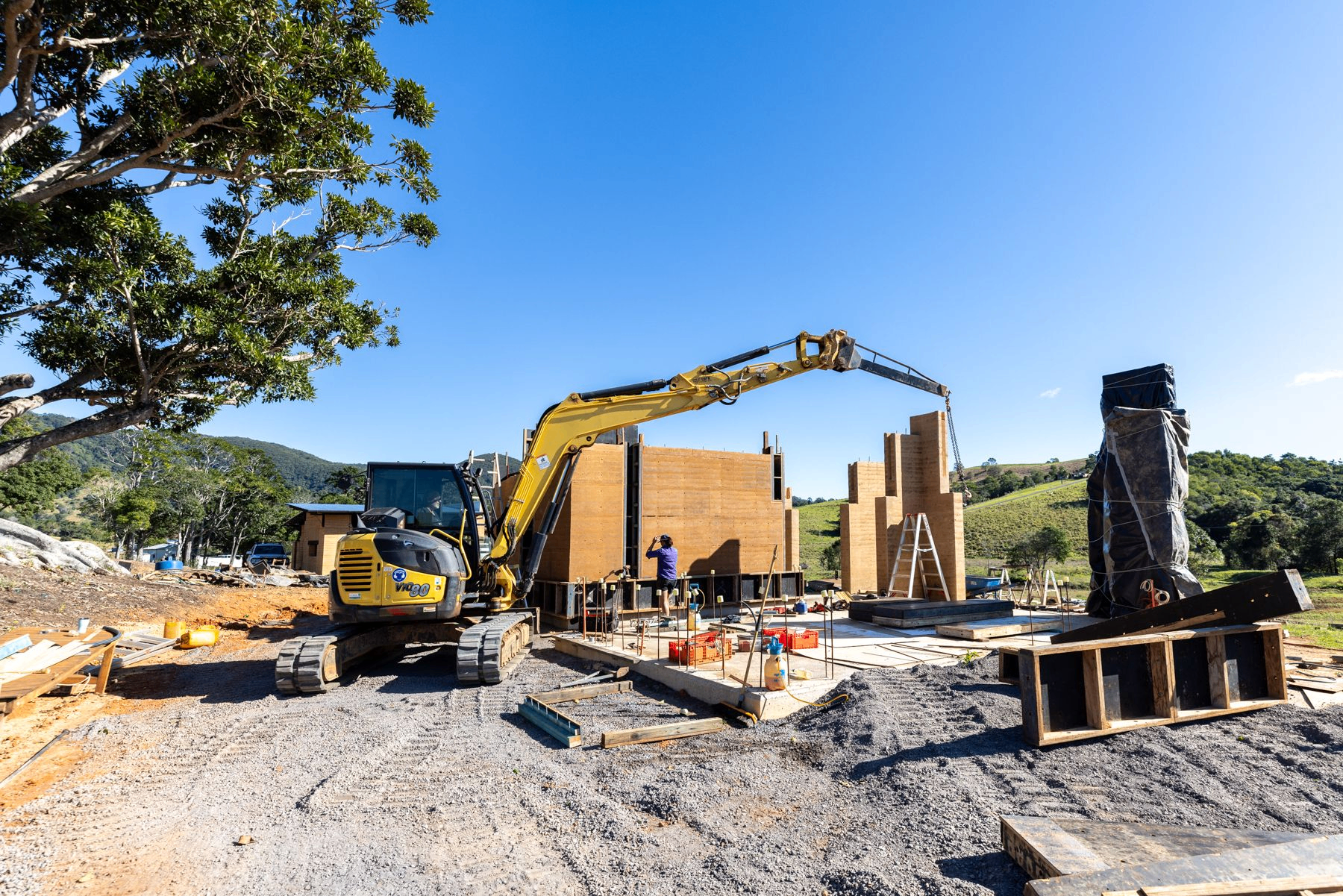
Rammed earth is one of the oldest building methods known to us. Sections of the Great Wall of China were built with it more than two thousand years ago, and it remains one of the best answers we have to building for a warmer climate.
How a rammed-earth wall is made
The recipe is deceptively simple: subsoil — a specific mix of clay, sand and gravel in the right proportions — a small amount of cement or lime as a stabiliser, and just enough water to bring the mix to what builders call "optimum moisture content". Squeeze a handful and it should hold its shape without dripping.
Timber or steel formwork is set up on the footings — essentially a long, tall box the shape of the finished wall. The damp mix is shovelled in a hundred millimetres at a time, then compacted with a pneumatic rammer until it drops to about half its loose height and rings solid. Then the next layer goes in, and the next.
The formwork can be stripped within hours. What's left is a solid, load-bearing wall with the colour and grain of the earth it was made from — layered like sedimentary stone, and warm to the touch.
Where it comes from
Archaeologists have found rammed-earth structures dating back more than five thousand years, in North Africa, the Middle East and northern China. Long sections of the Great Wall — the oldest surviving parts — are rammed earth rather than stone. The Alhambra in Spain, the kasbahs of Morocco and much of pre-industrial rural France were all built the same way.
In Australia the technique arrived with the earliest colonial builders and has never really disappeared. In the last few decades it has been quietly revived — first by desert architects working in the Northern Territory and Western Australia, then more widely — as an answer to the shortcomings of lightweight construction in a hot climate.
Why we chose it
Rammed earth has serious thermal mass. Walls three hundred to four hundred and fifty millimetres thick absorb the day's heat and release it slowly overnight — and do the reverse in winter. Inside the villas the temperature barely moves through a Queensland summer, with almost no air conditioning required.
The walls are also fire-resistant, termite-proof and acoustically dense — you cannot hear one villa from the next. They do not off-gas, they need no paint, and they will still be standing in a hundred years with almost no maintenance.
And they are beautiful in a way that photographs never quite catch. The layers of the pour read as horizontal bands of colour — ochre, umber, iron red — that shift with the light through the day.
Made from the site
Wherever possible, the soil used in the villa walls came from the site itself — the same earth that had been sitting under the paddock for millennia. The embodied energy of a rammed-earth wall is a fraction of a comparable brick or concrete wall, because there is almost no transport, almost no firing and almost no processing.
It is about as local as a building material gets, and it means each villa is, quite literally, made of the ground it stands on.